The Beginner's Guide to a Shadowboxing Workout
Quick Answer: A beginner shadowboxing workout is three-minute rounds with 30–60 seconds of rest, starting with 3–5 rounds — about 15–20 minutes. Round 1 is stance and footwork, rounds 2–4 are punches and simple combos (jab, cross, hook, uppercut), and the last round is free movement. No gloves, no bag, no partner, no space beyond a couple of square meters. Form first, speed later.
Shadowboxing is boxing with everything removed except the part that actually builds you: movement, timing, and repetition against nothing.
Which turns out to be the ideal starting point. There’s no equipment to buy, no bag to hit wrong, no partner to be embarrassed in front of — just you working out how a punch is supposed to feel.

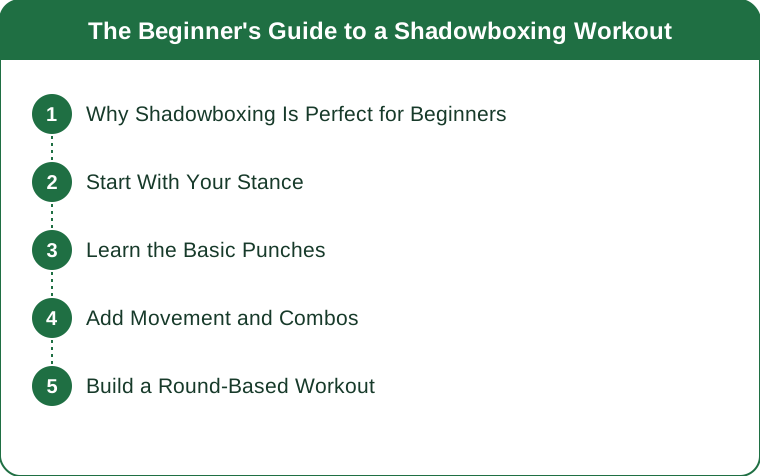
Why is shadowboxing perfect for beginners?
Nothing to buy and nowhere to go. A patch of floor and a timer. That removes the two biggest reasons beginner training plans die in week one.
Nothing to hit wrong. Bag work punishes bad wrist alignment immediately; shadowboxing lets you build the movement pattern first, so that when you do eventually hit something, your wrists are already in the right place.
You set the pace. Slow motion is allowed and, early on, encouraged. Try that in a class.
Nobody is watching. For a lot of people that’s the actual barrier to starting boxing at all — and it’s the reason shadowboxing builds confidence faster than a gym environment does. Six weeks alone in your living room and you walk into a class already knowing the vocabulary.
And it never stops being useful. Professional fighters shadowbox every single session. This isn’t a beginner’s substitute for real training — it is real training.
What’s the right boxing stance?
Everything is built here, so give it a full session before you throw anything.
- Feet shoulder-width, staggered. Left foot forward if you’re right-handed (orthodox), right foot forward if you’re left-handed (southpaw). Back heel slightly lifted.
- Knees soft, weight balanced roughly 50/50, ready to move in any direction.
- Hands up at cheek height, elbows tucked in against your ribs to protect your body.
- Chin down, eyes up. This feels awkward for about a week and then feels normal forever.
Practice moving in that stance: step forward with the lead foot and follow with the rear; step back rear-first. Never cross your feet, never bounce heavily. Two minutes of this in front of a mirror is a genuinely productive workout segment.

What punches should you learn first?
Four, and they’re numbered for a reason — coaches call combinations by number.
- 1 — Jab. Lead hand, straight out and straight back. Fast, light, and the punch you’ll throw most.
- 2 — Cross. Rear hand, straight, with your back foot pivoting and your hips turning. This is where power actually comes from.
- 3 — Hook. Lead hand, elbow up at roughly 90°, turning on the lead foot. A short, tight arc — not a wide swing.
- 4 — Uppercut. Rear or lead hand travelling upward from a slight dip, driven by the legs.
Practice each one slowly for two weeks before adding any speed. Snap every punch back to your guard — a hand left hanging out is the habit that’s hardest to unlearn later.
Then string them: 1-2, 1-1-2, 1-2-3, 1-2-3-2. Four combinations will keep you busy for months.
How do you add movement and turn it into cardio?
This is the step that converts practice into a workout. Static punching is technique; moving punching is conditioning.
- Step, then punch. Never throw while your feet are still moving — plant, then fire.
- Punch, then move off. Throw a combination, then take two steps to the side. This builds the habit of not standing where you just were.
- Add a slip or a roll between combinations: a small lean of the head off centerline, or a dip under an imaginary punch. It doubles the leg work and makes the session feel like boxing rather than aerobics.
- Vary the tempo within a round — 20 seconds of fast output, then back to steady. That’s where the sweat comes from.
Keep your core braced throughout. The power travels floor → back foot → hips → core → fist, and the arm is the last, smallest link. If only your shoulders are tired, you’re punching with your arms.
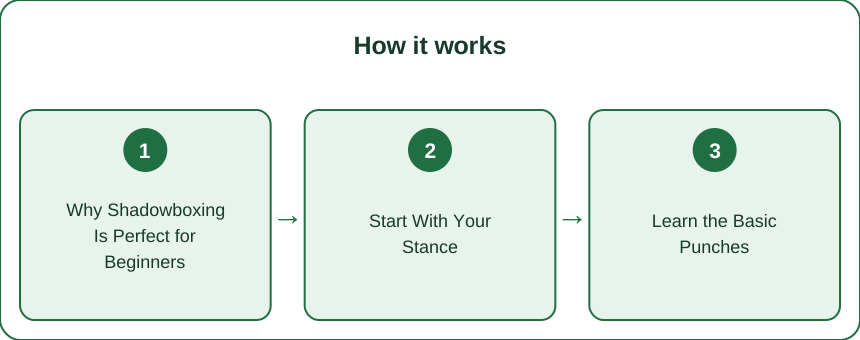
The round-based beginner workout
Set a timer for 3 minutes on, 45 seconds rest and let it run the session.
| Round | Focus |
|---|---|
| 1 | Stance and footwork only — forward, back, side to side |
| 2 | Jab and cross, slow and clean. Reset the guard every time |
| 3 | 1-2 and 1-1-2 combos with a step between each |
| 4 | Add the hook: 1-2-3, moving off after each combo |
| 5 | Free round — your pace, your combos, tempo changes |
Five rounds is about 19 minutes including rest, and it will surprise you. Start with 3 rounds if you’re new to training entirely, and add a round every week or two. Three sessions a week with a day between is the sustainable rhythm.
To make it harder later: shorten rest to 30 seconds, add 20-second all-out bursts at the end of each round, or hold 1–2 lb weights for a single round (no more — light weights over long rounds is how shoulders get irritated).
5 Mistakes Everyone Makes Shadowboxing
- Dropping the rear hand. Universal. Film 30 seconds on your phone and you’ll spot it instantly.
- Punching from the arm with no hip rotation. You’ll be exhausted, sore in the shoulders, and slow to improve.
- Locking out the elbow at full extension. Extend fully, but keep a fraction of bend. This is the shadowboxing-specific injury, because there’s nothing out there to stop your arm.
- Going fast before the form is clean. Speed built on bad mechanics has to be dismantled later. Slow is genuinely faster here.
- Holding your breath. Exhale sharply on every punch. The third mistake surprises even experienced people, but this one is why beginners gas out at 90 seconds and blame their fitness.
Mini FAQ
Is shadowboxing a good workout on its own?
Yes. Five hard rounds elevates your heart rate comparably to interval cardio while training coordination, footwork and core rotation — and unlike a bag session, it costs nothing and can be done anywhere. It won’t build much upper-body strength on its own, so pair it with push-ups, rows and squats a couple of times a week.
How long should a beginner shadowbox?
Fifteen to twenty minutes, three times a week. That’s 3–5 rounds. Longer sessions early on tend to degrade your form badly, and practicing sloppy technique for 40 minutes is worse than practicing clean technique for 15.
Should I shadowbox in front of a mirror?
Yes if you have one — it’s the fastest feedback loop for spotting a dropped hand or a wide hook. If not, film a round on your phone once a week and watch it back. Almost everyone finds something in the first thirty seconds.
TL;DR:
- 3-minute rounds, 45s rest, starting at 3–5 rounds — 15–20 minutes total.
- Spend the first session on stance and footwork only.
- Learn 1-2-3-4 (jab, cross, hook, uppercut) slowly before adding speed.
- Combos: 1-2, 1-1-2, 1-2-3, 1-2-3-2. That’s enough for months.
- Plant, punch, move off — and return every hand to your guard.
- Exhale on every punch; power comes from the floor, not the arms.
Space and effort, nothing else — and a quiet confidence that follows you out of the room.
Keep Reading
This article is for general informational and styling purposes only. Fit, sizing, and product availability may vary.