Why the Double End Bag Humbles You After Months on the Heavy Bag
Quick Answer: The heavy bag rewards power and stays where you put it. The double end bag rewards timing, accuracy and recovery of your guard — it moves unpredictably and punishes any punch you do not retract. If you can dominate a heavy bag and cannot touch a double end bag, the gap is almost always hand return speed and head position, not power. Start slow, at a longer elastic tension, and hit at 40 percent.
You have been on the heavy bag for eight months. Your combinations are clean, the bag moves, your hands hurt in the satisfying way.
Then someone points you at the double end bag and within ninety seconds it has hit you in the face twice and you have made contact maybe four times out of twenty.
That is not a failure of your training. It is the double end bag doing exactly its job: measuring the things a heavy bag cannot measure.

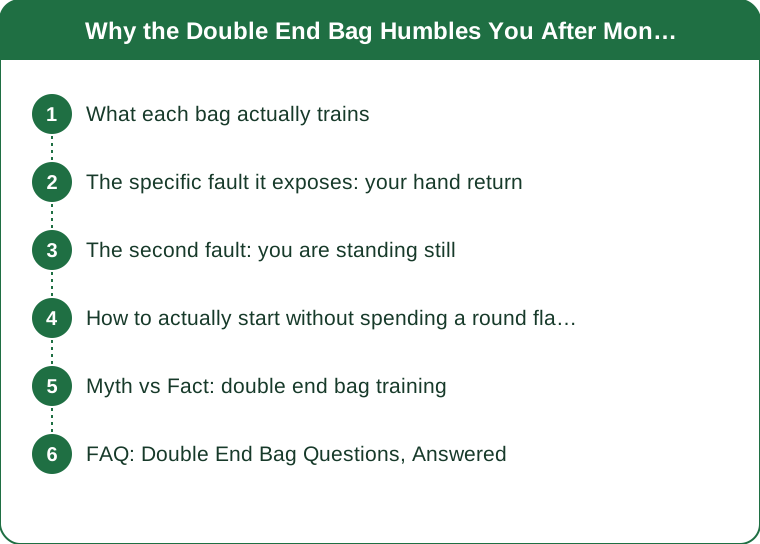
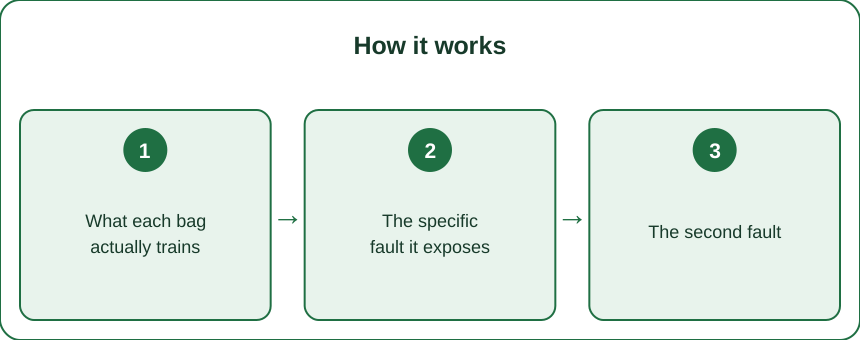
What each bag actually trains
These are not two versions of the same tool. They test different attributes.
The heavy bag measures force production and endurance. It is stationary, it absorbs, and it gives you feedback about power through sound and movement. Critically, it does not punish a slow hand return — you can leave a punch out for a full second and nothing happens.
The double end bag measures timing, accuracy, rhythm and defensive recovery. It is suspended between two elastics, so it rebounds along a predictable line at an unpredictable speed depending on where and how hard you hit it.
The mechanism that makes it hard: the bag comes back. If your hand is still out, it hits your hand. If your head is where it was, it hits your head. There is a direct, immediate consequence for every punch you do not retract and every position you do not leave.
This is why it feels like a completely different sport. It is testing the half of boxing that a stationary target physically cannot.
The specific fault it exposes: your hand return
Nine times out of ten, this is the answer.
On the heavy bag, the reward is in the impact. So attention goes to the outward journey — the drive, the rotation, the landing. The return is an afterthought, because nothing depends on it.
A punch has two halves, and the return is the more important one defensively. The hand that is not back is the guard that is not there.
The double end bag makes this visible in about four seconds. You jab, the bag snaps back along the elastic, and it arrives exactly where your hand should have already left.
How to fix it deliberately:
- Practise jab and return with nothing else, for a full round. Not combinations. One punch, snap back to the cheek, reset. Aim for the return to be faster than the punch, which is the standard cue for a reason.
- Return to the face, not to the chest. The most common fault is hands drifting down on the return, which the double end bag will find immediately.
- Count the retraction: out on one, back on one. If you are counting only the out, you are training half a punch.
The second fault: you are standing still
On a heavy bag, standing in front of it is fine. It is not going anywhere and it is not hitting back.
The double end bag rebounds toward you along a line. If you stay on that line, you get hit. If you move off it, you do not.
The specific habit it builds: hit and move. Not a big step — a few inches of head movement, a slip, a small angle change. This is the single most transferable skill from the double end bag to actual sparring.
The drill that teaches it: throw a jab, then slip immediately to the outside. The bag returns through the space where your head was. Repeat until the slip happens without deciding.
Why heavy bag work can build the opposite habit: if you have spent months planted in front of a stationary target, you have trained your feet to stay. That is a real habit and it needs undoing, which is uncomfortable and why the double end bag feels like going backwards.
The reassuring part: most people go from unable to touch it to a reasonable rhythm in about three to four sessions. It is a fast adaptation, because the feedback is immediate and unambiguous.

How to actually start without spending a round flailing
Loosen the elastics first. A longer, slacker setup means slower rebound and a more predictable line. Tight elastics mean a fast, erratic bag, and that is an advanced setting, not a default. Almost every gym leaves them too tight.
Hit at 40 percent power. This is the instruction people resist and it is the whole thing. Hard punches make the bag move fast and unpredictably, which means you spend the round chasing rather than learning. Light punches produce a controlled, rhythmic rebound you can actually work with.
Start with the jab alone. One punch, one rebound, one reset. Find the rhythm before adding anything.
Then jab-jab. Timing the second jab to the return of the first is the core skill, and it teaches you rhythm faster than any combination.
Then add the cross. One-two, with the specific goal of the jab hand being back before the cross lands.
Only then add movement and head slips.
Round length: two minutes is plenty at first. The concentration cost is much higher than the heavy bag, and quality falls off fast when you are tired.
Myth vs Fact: double end bag training
Myth: You need to be advanced to use it. Fact: It is arguably a better beginner tool than the heavy bag, because it builds correct habits from the start instead of reinforcing a planted stance and a lazy return. It just needs the elastics slack and the ego parked.
Myth: If you cannot hit it, your technique is bad. Fact: Your technique is probably fine. Your timing has never been tested. These are separate attributes and one does not imply the other.
Myth: Hitting it harder is progress. Fact: Hitting it accurately and rhythmically is progress. Power on a double end bag mostly produces a wildly swinging bag and a frustrating round.
Myth: It replaces heavy bag work. Fact: It cannot build the same force output or the same conditioning. Most sensible boxing training uses both — heavy bag for power and conditioning, double end bag for timing and defence, and neither substitutes for the other.
Myth: Getting hit by it means you are doing it wrong. Fact: Getting hit by it is the feedback. That is the entire pedagogical point of the tool, and everyone including professionals gets hit by it.
FAQ: Double End Bag Questions, Answered
How long should it take before I stop missing?
Most people find a workable rhythm on the jab within two or three sessions, and combinations within a few weeks. If you are still flailing after a month, the elastics are almost certainly too tight and you are almost certainly hitting too hard.
What should the elastic tension be?
Start with the bag hanging with visible slack, moving slowly when tapped. Tighten it progressively as your timing improves. Tension is a difficulty dial, and most gyms have it set at maximum by default.
Can I use it if I only train at home?
Yes, and it is one of the better home purchases in boxing — it takes little space, makes far less noise than a heavy bag, and trains attributes you cannot train shadowboxing. It needs a solid anchor above and below, which is the main constraint in an apartment.
This is general information, not coaching. Wrap your hands for bag work, and any wrist or hand pain that persists after a session deserves attention rather than another round.
TL;DR:
- The heavy bag measures power and never punishes a slow hand return; the double end bag punishes it within four seconds.
- Nine times out of ten the gap is retraction speed — practise jab and return alone, faster back than out, returning to the cheek.
- It also exposes standing still, because the bag rebounds along a line you need to leave; hit and slip is the core habit it builds.
- Loosen the elastics and hit at 40 percent — most gyms leave the tension at an advanced setting by default.
- Jab, then jab-jab, then one-two, then movement. Two-minute rounds until the rhythm arrives, usually in three or four sessions.
The little bag is not making you worse. It is testing the half of boxing your stationary target never asked about.
Keep Reading
This article is for general informational and styling purposes only. Fit, sizing, and product availability may vary.