Why Your Punches Lose Power Late in a Round (It's Not Just Fatigue)
Quick Answer: Punch power typically drops late in a round because fatigue causes hip rotation to shorten, guard to drop, and punches to become more arm-driven instead of full kinetic-chain driven — conditioning matters, but technique breakdown under fatigue explains most of the power loss people blame purely on being tired.
Most boxers assume declining power late in a round is simply a cardio problem. Technique is usually the bigger, more fixable factor.

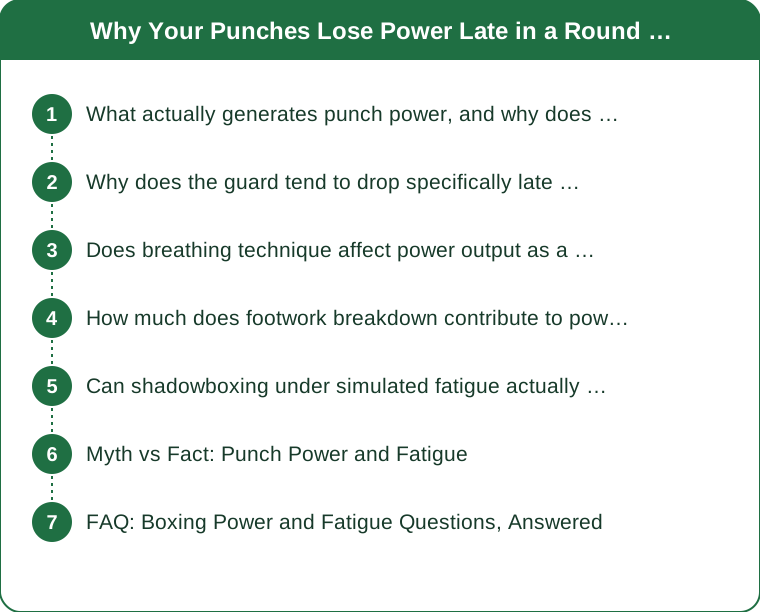
What actually generates punch power, and why does it fail first under fatigue?
Real punch power comes from the kinetic chain — hip rotation and leg drive transferring force up through the torso into the shoulder and fist — not from arm strength alone. Under fatigue, hip rotation is one of the first things to shorten and slow down because it requires more coordinated full-body effort than simply throwing the arm, which is why power specifically (not just speed) drops before a fighter feels fully exhausted.
Why does the guard tend to drop specifically late in a round?
Holding the guard up requires sustained shoulder and arm endurance that’s separate from punching power itself, and as those muscles fatigue, the guard drifts down even if a fighter still has decent punching output left. A dropped guard also makes punches look and feel weaker because the setup and combinations that generate real power depend on a stable base position the guard helps maintain.
Does breathing technique affect power output as a round wears on?
Yes — many boxers unconsciously hold their breath or breathe shallowly as fatigue sets in, which reduces oxygen delivery to working muscles and accelerates the very fatigue causing the power drop in the first place. Exhaling sharply on each punch, a habit that’s easy to maintain fresh but often abandoned under fatigue, helps sustain power output later into a round.

How much does footwork breakdown contribute to power loss?
Power punches need a stable base to rotate against, and tired legs often start planting flat-footed or off-balance, which removes the ground force a punch needs to transfer power upward. This is why conditioning work that specifically trains footwork under fatigue (not just general cardio) transfers more directly to maintained punch power than running alone.
Can shadowboxing under simulated fatigue actually help fix this?
Yes — practicing combinations at the end of a hard cardio round, rather than always practicing technique fresh, trains the body to maintain hip rotation and form specifically under the fatigued state where power normally breaks down. Most gym time is spent drilling technique fresh, which builds a skill that doesn’t transfer well to the exact moment (late round, tired) where it’s needed most.
Myth vs Fact: Punch Power and Fatigue
Myth — losing power late in a round just means you need better cardio. Fact — technique breakdown, especially reduced hip rotation and a dropping guard, explains more of the power loss than pure conditioning limits. Myth — arm strength is what makes punches powerful. Fact — hip rotation and leg drive generate the majority of real punch power, with arms mainly transmitting rather than creating it.
FAQ: Boxing Power and Fatigue Questions, Answered
Should you slow your pace early in a round to preserve power later?
A smart pace does help, but the bigger fix is training technique under fatigue specifically, since pacing alone doesn’t fully solve a hip-rotation breakdown.
Does hand wrap or glove choice affect perceived power loss?
Not meaningfully for power generation itself, though proper wrapping protects the wrist and hand from injury as punching form starts to break down under fatigue.
How long does it take to notice improvement from fatigue-specific technique training?
Most boxers notice better maintained power output within 3-4 weeks of regularly practicing combinations at the end of conditioning rounds rather than only when fresh.
TL;DR:
- Power loss late in a round is mostly a technique breakdown issue, not just cardio
- Hip rotation shortens under fatigue before a fighter feels fully exhausted
- A dropping guard and flat-footed stance both quietly reduce usable punch power
- Practicing combinations under simulated fatigue transfers better than always drilling fresh
Cardio conditioning still matters, but the fastest fix for late-round power loss is training technique to hold up under fatigue, not just building a bigger gas tank.
Keep Reading
This article is for general informational and styling purposes only. Fit, sizing, and product availability may vary.