Why Your Punches Feel Noticeably Weaker Deep Into a Sparring Round
Quick Answer: Punch power relies heavily on hip and leg drive transferring force through a stable core, and fatigue affects that kinetic chain’s coordination well before it affects raw arm strength — which is why punches go ‘flat’ before you feel generally exhausted. Round-specific conditioning drills targeting hip drive under fatigue address this directly.
Your arms don’t feel dramatically weaker by round three, but your punches clearly are — flatter, less snap, less actual force landing. The disconnect between how tired you feel and how weak your punches have become points to something more specific than general conditioning.

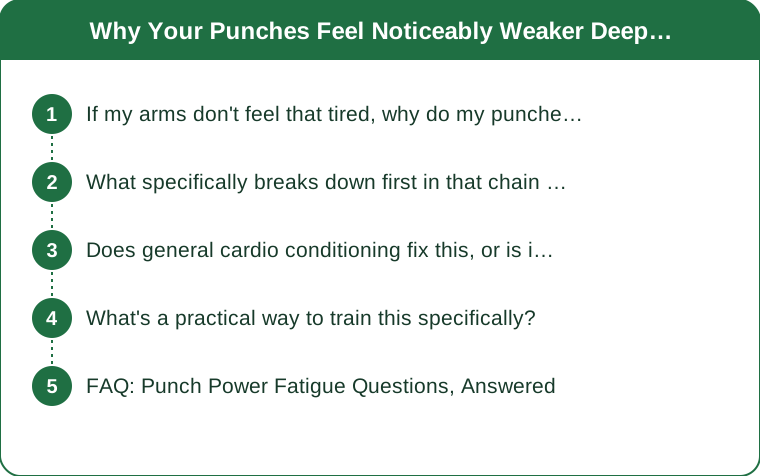
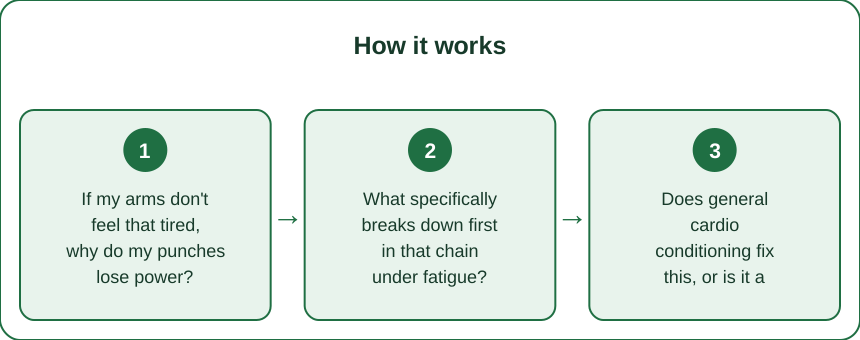
If my arms don’t feel that tired, why do my punches lose power?
Real punching power comes primarily from the kinetic chain — hip rotation and leg drive transferring force up through a stable core into the arm, not arm strength alone. This coordinated sequence is more sensitive to fatigue than raw arm muscle endurance, so the chain breaks down (and power drops) well before your arms alone feel exhausted.
What specifically breaks down first in that chain under fatigue?
Hip rotation speed and timing tend to degrade first, since they require more coordinated, fast-twitch muscular effort than the arm’s role in the punch. Once hip drive slows or mistimes, the arm ends up doing more of the work in isolation — which produces a technically similar-looking punch that generates significantly less actual force.

Does general cardio conditioning fix this, or is it a different kind of fitness?
General cardio conditioning helps you last longer overall, but doesn’t specifically train the coordinated hip-drive-under-fatigue pattern a punch needs. Sport-specific conditioning — rounds that combine punching output with the actual fatigue state of sparring — trains the exact skill that’s breaking down, in a way steady-state cardio alone doesn’t.
What’s a practical way to train this specifically?
Heavy bag rounds structured to match your actual sparring round length and intensity, with deliberate focus on maintaining full hip rotation through the final 30-60 seconds of each round, directly targets the breakdown point. Some coaches use call-outs specifically in the final segment of a round to cue conscious hip engagement when it’s most likely to fade.
FAQ: Punch Power Fatigue Questions, Answered
Is this pattern different for boxers versus other combat sports?
The underlying kinetic chain principle is similar across striking sports, though the specific power-generation mechanics differ somewhat between boxing, kickboxing, and other styles.
How long does it take to notice improvement from fatigue-specific conditioning?
Most athletes report a noticeable difference in maintained round-three-and-later power within 4-6 weeks of consistently training fatigue-state rounds, roughly matching typical conditioning adaptation timelines.
Should beginners worry about this or focus on basics first?
Basics first — fatigue-specific power conditioning is a refinement that matters most once fundamental hip-drive punching technique is already solid; training it too early without the base technique doesn’t transfer as well.
TL;DR:
- Punch power comes from hip and leg drive through a kinetic chain, not arm strength alone
- That coordinated chain degrades under fatigue faster than raw arm endurance does
- General cardio conditioning helps overall stamina but doesn’t specifically train this breakdown point
- Structured heavy bag rounds matching real fatigue conditions target the exact skill that’s failing
Keep Reading
This article is for general informational and styling purposes only. Fit, sizing, and product availability may vary.