Why Your Jab Gets Slower When Your Legs Get Tired
Quick Answer: Your jab slows when your legs fatigue because punch speed is produced by ground force traveling up through the hips and torso, not by arm speed. Tired calves and quads shorten your stance, flatten your push-off, and reduce hip rotation, so the arm has to generate more of the punch on its own — which is both slower and weaker. Train calf and hip endurance, not arm speed.
Round one, the jab snaps. Round four, it floats.
Most people respond by trying to throw the arm faster, which makes it worse — the shoulder tightens, the punch telegraphs, and now it is slow and readable.
The jab did not slow down. The floor stopped pushing.

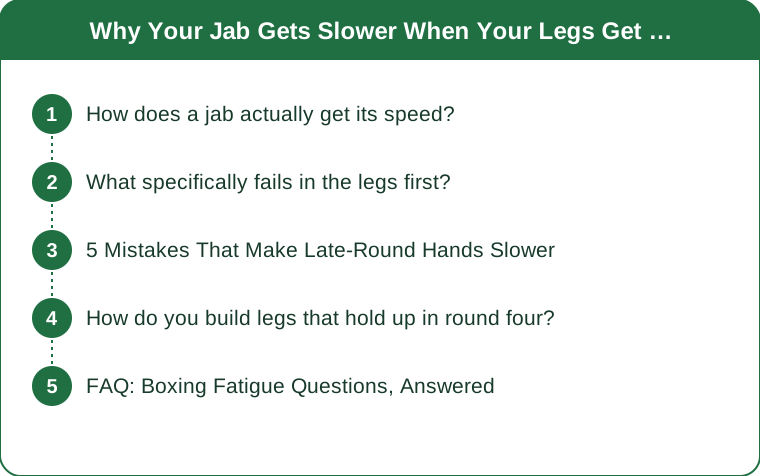
How does a jab actually get its speed?
A jab is a chain, and the arm is the last link, not the first.
The sequence: the rear foot presses into the floor, the ground pushes back, that force travels through the lead leg and hip, the torso rotates, the shoulder accelerates, and the fist arrives. Each segment adds velocity to the next.
Estimates vary by athlete and study, but the consistent finding across boxing biomechanics work is that the majority of punch velocity is produced below the shoulder. The arm contributes far less than it feels like it does.
Which means when your legs fatigue, you are losing the biggest contributor to speed while your arm — which never fatigues as fast — is left trying to cover the shortfall it cannot cover.
What specifically fails in the legs first?
Three things, in this order:
- Calves. Staying on the balls of your feet is a sustained low-level calf contraction across an entire round. When they fatigue, the heels drop, and a flat foot cannot push off. This is usually the first failure and the most visible one.
- Hip rotators. The glute medius and the deep rotators drive torso turn. Fatigued, your rotation shrinks and the jab becomes an arm punch with a shoulder lean.
- Quads, through stance creep. As they tire, the stance widens and the knees straighten, both of which slow direction changes and reduce the elastic loading a good push-off depends on.
Watch any round-four sparring video. The stance is wider, the heels are down, the head is higher. Every one of those is a leg-fatigue symptom that shows up as slow hands.

5 Mistakes That Make Late-Round Hands Slower
- Bouncing constantly. Continuous bouncing burns calf endurance for no defensive benefit. Stay light but settled; move with purpose, not rhythm-for-its-own-sake.
- Holding your breath during combinations. Exhale sharply on every punch. Breath-holding accelerates whole-body fatigue faster than almost anything else in the round.
- Training arms for punch speed. Speed bag work and light dumbbell punches build very little of what actually produces velocity. Skipping rope, pogo hops, and calf raise endurance transfer far more.
- Standing too wide from the start. A wide stance feels stable but costs energy on every direction change, and it flattens your push-off.
- Doing conditioning only at the end of a session. Round-specific fatigue needs to be trained under skill demands. Adding a 3-minute bag round after a hard leg circuit teaches the chain to work tired.
Number three is where most people spend their extra training time, and it returns the least.
How do you build legs that hold up in round four?
Train the specific quality: repeated short elastic efforts with incomplete rest.
- Jump rope, 3 rounds of 3 minutes, 60 seconds rest, staying on the balls of your feet the entire round. This is the single highest-transfer drill available and it is free.
- Pogo hops, 4 sets of 20, minimal ground contact time. Trains calf stiffness, which is what preserves push-off when tired.
- Lateral bounds, 3 sets of 8 per side. Builds the hip rotators and the direction-change capacity the stance depends on.
- Split squat holds, 3 sets of 30 seconds per side in a boxing stance. Unglamorous, extremely effective for stance integrity late in a round.
- Shadowboxing with intent, 2 rounds after conditioning, focusing purely on rear foot pressure into the floor.
Two sessions a week for four to six weeks is enough to change how round four feels. And check your shoes — a cushioned running shoe absorbs the ground force you are trying to transmit. Flat soles transmit; foam eats.
FAQ: Boxing Fatigue Questions, Answered
Should I train through the slow-hands feeling or stop?
Train through it, but with attention on mechanics rather than output. The point of late rounds is learning to maintain the chain while tired, not throwing harder.
Does upper body strength help punch speed at all?
It helps with structure, transmission, and durability more than with velocity. A strong torso transfers leg force efficiently; a weak one leaks it. But no amount of bench pressing fixes a flat back foot.
Why does my jab feel fine on the pads but slow on the bag?
Pad work is usually shorter, with more rest and less continuous stance loading. The bag rounds expose leg endurance more honestly, which is useful information rather than a discouraging sign.
TL;DR:
- Most punch velocity comes from ground force through the legs and hips, not the arm
- Calves fail first, heels drop, push-off flattens, and hands appear to slow
- Rope work, pogo hops, and lateral bounds transfer more than speed bag or light dumbbell punching
- Exhale on every punch, avoid pointless bouncing, and wear flat-soled shoes
Next session, watch your heels in round three. If they are on the floor, you have found your slow jab — and it is a conditioning fix, not a technique one.
Keep Reading
This article is for general informational and styling purposes only. Fit, sizing, and product availability may vary.