Why Your Hands Ache More After Some Heavy Bag Sessions Than Others, Even With the Same Wraps
Quick Answer: Inconsistent hand soreness after heavy bag sessions, despite identical wraps and gloves, is most often explained by punch technique breaking down as fatigue builds during that specific session — a properly aligned punch transmits force safely through the wrist and forearm, while a fatigued, slightly misaligned punch concentrates more impact stress directly on the hand and knuckles.
The wraps and gloves are doing their job consistently. What changes session to session is how well your form holds up as you get tired, and that’s usually where the extra soreness comes from.

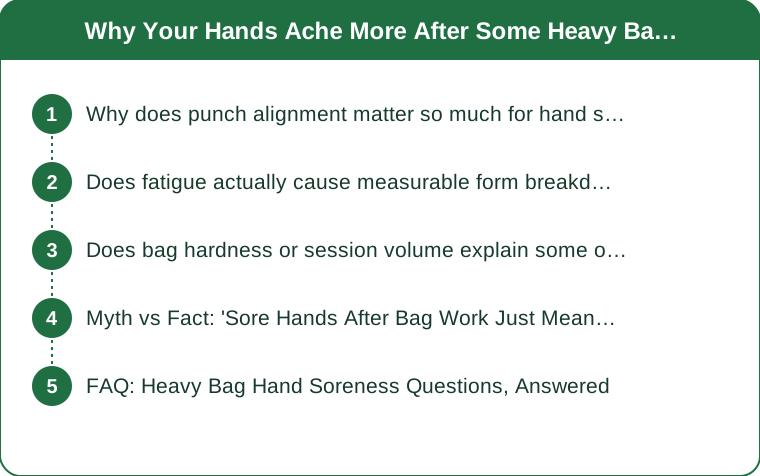
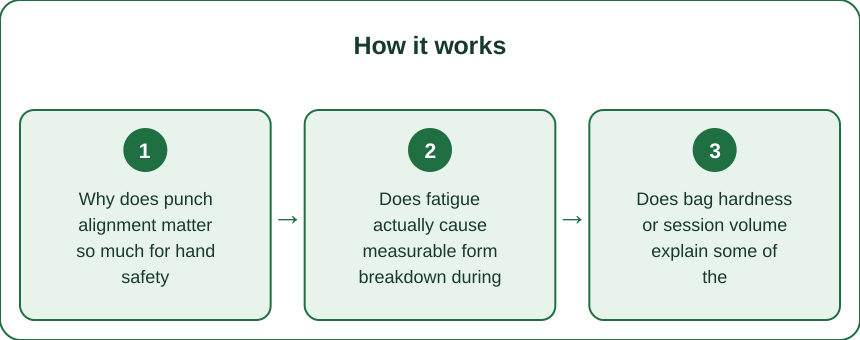
Why does punch alignment matter so much for hand safety specifically?
A properly aligned punch lands with the first two knuckles and keeps the wrist in a straight, neutral line back through the forearm, which allows impact force to transfer efficiently into the larger, more impact-tolerant bones and muscles of the arm — even a small deviation in wrist angle or knuckle contact point concentrates that same force onto a smaller, less protected area of the hand.
Does fatigue actually cause measurable form breakdown during a single session?
Yes, and it’s a well-recognized pattern — as forearm and shoulder muscles tire through a session, maintaining precise wrist alignment on every single punch becomes harder, and a fatigued boxer will often unconsciously start landing punches slightly off-angle in the later rounds, exactly the point where cumulative impact stress on the hands is also highest.

Does bag hardness or session volume explain some of the session-to-session variation too?
It can contribute, though usually less than technique breakdown — a bag that’s been recently used heavily and packed down harder, or a session with unusually high total punch volume, both increase raw impact load independent of technique, but most experienced coaches point to late-session form breakdown as the more common and more controllable factor.
Myth vs Fact: ‘Sore Hands After Bag Work Just Mean You Hit Hard’
Myth: hand soreness after a heavy bag session is simply proof of a powerful, hard-hitting session. Fact: genuine punching power comes primarily from hip rotation and proper technique, not from impact felt in the hands — soreness concentrated in the hands and knuckles specifically, especially inconsistent from session to session, is more often a sign of alignment breakdown than a marker of a particularly effective workout.
FAQ: Heavy Bag Hand Soreness Questions, Answered
Should session length be shortened if late-round form breakdown seems to be the cause?
A reasonable approach — either shortening the overall session or adding brief rest between rounds specifically to reset form before continuing tends to reduce the fatigue-driven technique breakdown more effectively than just pushing through at the same intensity.
Does re-wrapping mid-session help if hands start feeling sore partway through?
Re-wrapping can restore some support if the original wrap has loosened significantly, but it doesn’t address a technique breakdown issue — checking and consciously resetting punch form is a more direct fix for that specific cause.
When does hand soreness after bag work cross from normal into something worth having checked?
Sharp, localized pain (rather than general soreness), swelling, or soreness that doesn’t improve within a couple of days are reasonable signs to have a hand checked, since they can indicate a more specific issue like a stress reaction in a knuckle bone rather than routine soreness.
TL;DR:
- Inconsistent hand soreness after identical equipment setups usually points to technique breakdown, not the gear
- Properly aligned punches transfer force safely through the wrist and forearm; misaligned ones concentrate it on the hand
- Fatigue late in a session commonly causes unconscious alignment breakdown, right when impact volume is highest
- Sharp or swelling pain, unlike general soreness, is worth having checked rather than assumed as normal
The wraps aren’t failing you session to session — late-session form usually is, and shorter, more form-conscious rounds fix it more reliably than better gear.
Keep Reading
This article is for general informational and styling purposes only. Fit, sizing, and product availability may vary.