Why Skipping Rope Improves Your Punches More Than Extra Bag Rounds
Quick Answer: Rope work improves punching because power comes from the ground up, and skipping trains the ankle stiffness, calf elasticity, rhythm and relaxed shoulder position that let force travel from your feet into your fist. Bag work trains the end of that chain. Rope trains the start of it, plus the aerobic base that keeps your technique intact in round four. Three rounds of rope beats a fourth round on the bag for most people.
The rope is not the boring part before the real training.
Watch anyone who punches hard and look at their feet. Then look at how they skip.
There is a reason those two things go together.

How does footwork actually produce punching power?
Because force is generated at the floor and everything above the ankle is transmission.
Power starts with ground reaction force. A punch begins as a push into the floor. The leg drive rotates the hip, the hip rotates the torso, and the arm delivers what arrives. If the foot is not pushing efficiently, everything downstream is smaller.
Ankle stiffness determines how much of that force survives. A stiff, elastic ankle transmits force. A soft one absorbs it. Skipping is fundamentally an ankle stiffness drill performed hundreds of times per round.
The stretch-shortening cycle is the same in both. Rope skipping trains the calf and Achilles to store and release elastic energy quickly. That is the same mechanism that makes a fast pivot fast.
Rhythm is a transferable skill. Boxing is timing under fatigue. The rope trains sustained rhythm with an immediate, unforgiving penalty for losing it.
Relaxation under load is trained too. You cannot skip for three rounds with tense shoulders. Learning to keep the upper body loose while the legs work hard is precisely the state you need for fast hands.
Bag work does not train any of this. It trains impact, accuracy, combinations and conditioning of the punch itself — which matters enormously, but it is the second half of the chain.
What does the rope give you that the bag does not?
Six things, and none of them are available from more rounds of hitting.
Low-impact aerobic volume. You can accumulate a lot of conditioning on the rope without the joint cost of running or the shoulder cost of the bag.
Coordination between upper and lower body. The wrists turn while the feet manage timing, and the two must stay independent. That independence is what allows punching while moving.
Foot speed without a partner. Double unders, alternating steps and boxer skip patterns build genuine foot speed that translates to ring movement.
Recovery-friendly work. Rope can be done at low intensity on days when your hands and shoulders need a break, keeping conditioning going without adding impact.
Immediate honest feedback. You either keep the rhythm or the rope hits your shins. The bag never tells you when your timing slipped.
Calf and foot durability. Boxers spend rounds on the balls of their feet. Rope builds the specific tissue capacity for it, which is why people who skip rarely get the calf problems that people who suddenly start moving on their toes do.
How should you actually structure rope work?
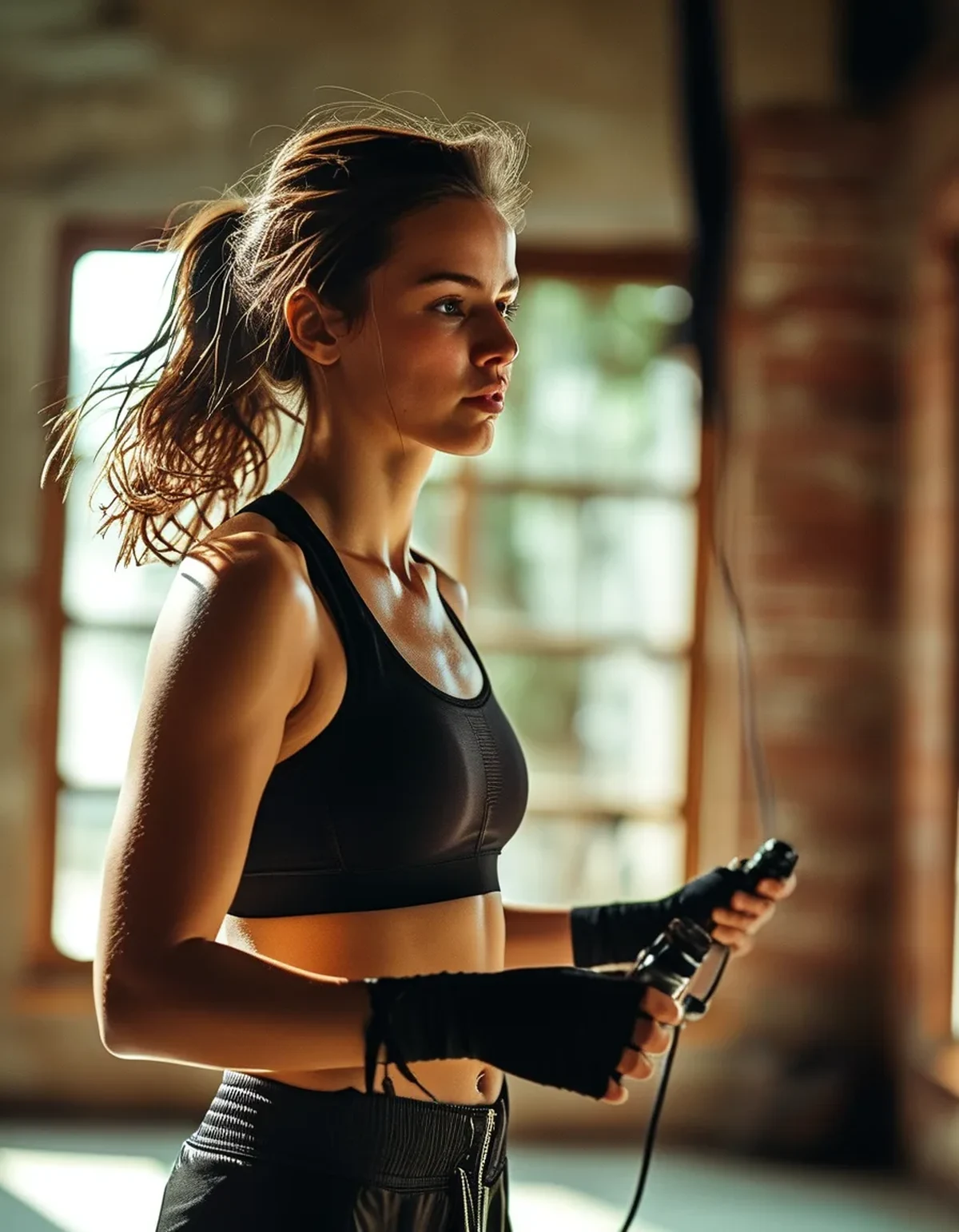
In rounds, with purpose, and more of it than you are currently doing.
Use three-minute rounds with one minute rest. Matching your sport is free specificity, and it builds the right work-to-rest tolerance.
Start with three rounds and build to six. Six rounds of rope is a genuinely useful session on its own, not just a warm-up.
Round one is a warm-up: basic bounce, relaxed. Get the shoulders loose and the rhythm established.
Rounds two and three are footwork: boxer skip, alternating step, side to side. These are the patterns that transfer directly to ring movement.
Round four onward is intensity: double unders, sprint intervals, high knees. Thirty seconds hard, thirty seconds steady, repeated.
Stay on the balls of your feet, low. Jump one to two centimetres, not ten. Big jumps are wasted energy and teach the opposite of what you want.
Keep the elbows in and turn the wrists. Rotating from the shoulders is the most common fault and it exhausts you within a round.
Add rope after bag work occasionally, not always before. Skipping while fatigued trains rhythm under fatigue, which is exactly the round-four skill.
Seasonal note: as it gets colder, calves and Achilles need a longer warm-up before rope work than they do in summer. Two minutes of easy bouncing before the first round prevents most of the early-autumn calf complaints that turn up in every gym.
Myth vs Fact: Rope and Punching Power
Myth: Rope is just cardio. Fact: It is a coordination, elasticity and rhythm drill that also happens to be excellent conditioning.
Myth: Punching power comes from the arms and shoulders. Fact: Most of it comes from the legs and hips. The arm delivers what the ground gives it.
Myth: More bag rounds is always the answer to a weak punch. Fact: If your feet are not producing force efficiently, more bag rounds train delivery of a smaller amount of force.
Myth: You should jump high to make it harder. Fact: Low and fast is both harder and more specific. Height is wasted vertical displacement.
Myth: Double unders are the goal. Fact: They are useful, but sustained relaxed rhythm for six rounds does more for your boxing than a personal best in double unders.
FAQ: Skipping for Boxing Questions, Answered
How long should I skip before a session?
At least one full round to warm up, ideally two. Three or more if rope is the session focus.
What rope should I use?
A lightweight speed rope for foot speed, a slightly heavier rope if you want more shoulder and forearm involvement. Length should reach roughly to your armpits when stood on.
My calves are always sore. Am I doing it wrong?
Usually too much too soon, or jumping too high. Build volume gradually and stay low. Persistent calf or Achilles pain is worth getting assessed.
Can I skip on concrete?
You can, but a mat or wooden floor is much kinder over time. Concrete accelerates calf and Achilles complaints.
Does rope build the same conditioning as running?
It builds excellent aerobic conditioning with more sport-specific movement and less joint impact. Many boxers use both, with rope as the higher-specificity option.
How do I stop tripping so much?
Slow down, jump lower, and turn from the wrists rather than the shoulders. Nearly every tripping problem is one of those three.
TL;DR:
- Punching power starts at the floor — rope trains ankle stiffness, elasticity and rhythm; the bag trains delivery.
- Rope builds low-impact conditioning, coordination and relaxed shoulders under load.
- Work in three-minute rounds, build from three to six, stay low and turn from the wrists.
- Occasionally skip after bag work to train rhythm under fatigue.
- Height is wasted. Low and fast is the standard.
Swap your fourth bag round for three rope rounds for a month and check your pivot speed.
Keep Reading
This article is for general informational and styling purposes only. Fit, sizing, and product availability may vary.