Why Shadowboxing Alone Plateaus Your Power Even After Months of Practice
You’ve been shadowboxing four times a week for five months. Your form looks genuinely good now. Your combinations are faster, your footwork is cleaner, and your timing is real.
Then you hit a heavy bag and it barely moves.
That’s not a sign you’ve been doing it wrong. It’s a sign you’ve been doing one thing very well, and that thing doesn’t happen to be power.
Quick Answer: Shadowboxing throws every punch against zero external resistance, so it trains coordination, speed, and timing — but never asks your muscles to produce force against a load. Power comes from load-bearing rotational work: heavy bag rounds and rotational medicine ball throws. Keep shadowboxing as your warm-up and technique tool, and add two dedicated power sessions a week. More shadowboxing reps won’t break the plateau.

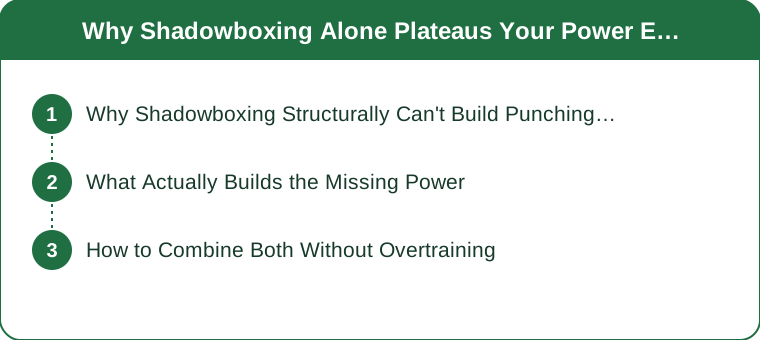
Why Can’t Shadowboxing Build Punching Power?
Because there’s nothing to push against.
Force production is a trainable quality, and the way you train it is by asking muscles to generate force against resistance. Shadowboxing has, by definition, none. Your fist meets air. Your muscles accelerate your arm and then have to decelerate it before your elbow hyperextends — which means a meaningful share of the work in a shadowboxed punch is spent braking, not driving.
What shadowboxing does train, and trains well:
- Coordination and movement patterning — the kinetic sequence from foot to hip to shoulder to fist.
- Speed of the unloaded movement.
- Timing, rhythm, and footwork.
- Conditioning, at volume.
Those are genuinely valuable, and they’re why every boxing gym in the world starts every session with it.
What it can’t train is the thing that makes a punch land hard: the ability of your hips and core to produce and transmit force into something that resists. Punching power comes mostly from ground reaction force driven through your legs and hips, transferred through a stiff core, and delivered by the arm — and the load-bearing parts of that chain need loaded practice.
So the plateau is a structural gap, not a technique failure. You could shadowbox for another five months with perfect form and it wouldn’t close, because the drill isn’t built to train force production at all. That’s worth sitting with for a second, because most people respond to a plateau by doing more of what caused it.

What Actually Builds Punching Power?
Two things, and they’re complementary rather than interchangeable.
Heavy bag work. This is shadowboxing plus resistance. The bag gives your punches something to actually drive into, which means your body finally has to produce force rather than just accelerate a limb. It also gives you honest feedback — a technically pretty punch that doesn’t move the bag was never a powerful punch, and you find that out immediately.
Bag work also trains the deceleration and impact-absorption side, which shadowboxing can’t touch: your wrist, shoulder, and core learn to stay rigid at the moment of contact so force transfers instead of leaking.
Rotational medicine ball throws. These train the hip-driven, core-transmitted rotational force production that underlies every hook and cross, without the technical load of punching. Because you’re throwing the ball and releasing it, there’s no braking phase — you can accelerate through the whole range, which is exactly what you can’t do in the air.
The core movements:
- Rotational throw against a wall — side-on, feet planted, rotate hard from the hips and release. 3 sets of 6–8 per side.
- Overhead slam — full-body extension into the floor. 3 × 8.
- Step-and-throw — adds the weight transfer that mirrors a cross.
Keep the reps low and the intent maximal. Power work is not conditioning work — every rep should be explosive, with full rest between sets (60–90 seconds). If you’re getting tired enough that the throws slow down, you’ve turned a power session into a cardio session and you’ll train the wrong quality.
Supporting strength work — squats, deadlifts, and dedicated core anti-rotation work like Pallof presses — builds the underlying force capacity that both of the above express.
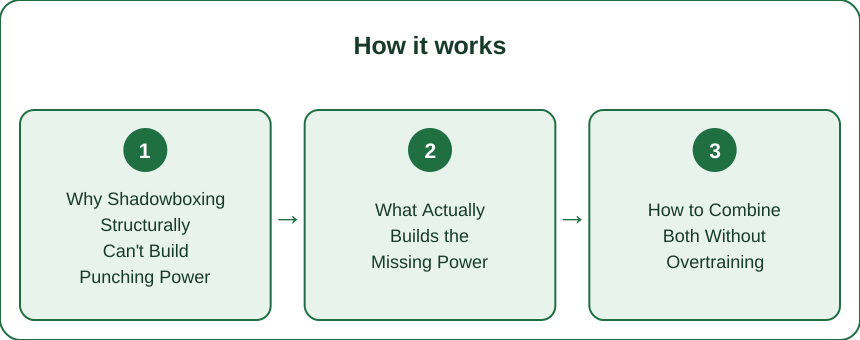
How Do You Add Power Work Without Overtraining?
Split the jobs. Stop asking one drill to do both.
A workable weekly structure:
- Shadowboxing: as a 5–10 minute warm-up before every session, plus one dedicated technique session. This is what it’s actually good at — keep it.
- Power work: two dedicated sessions per week, on non-consecutive days. Each one is 3–4 rounds of focused heavy bag work plus 10–15 minutes of medicine ball throws. Roughly 30 minutes total.
- Strength: one to two sessions, if you have the time.
- Rest: at least one full day.
Two things that keep this sustainable:
Do power work when you’re fresh. Early in the session, after the warm-up, before conditioning. Explosive quality collapses when you’re fatigued, and a tired power session trains endurance while feeling like power training.
Ramp the bag gradually. Heavy bag work is genuinely hard on wrists, knuckles, and shoulders in a way shadowboxing isn’t — you’ve spent months with zero impact loading, and your connective tissue hasn’t adapted. Wrap your hands properly every time, start with lighter contact for the first couple of weeks, and build up. Wrist pain, persistent knuckle soreness, or shoulder pain that lingers past a day is a signal to back off and, if it continues, get it looked at.
Myth vs Fact
Myth: More shadowboxing eventually builds power. Fact: It builds speed, coordination, and endurance indefinitely, but force production requires resistance, and shadowboxing has none by definition. The plateau is structural.
Myth: Punching power comes from your arms. Fact: It comes primarily from the ground up — legs driving, hips rotating, core transmitting. The arm delivers force it didn’t generate. This is exactly why rotational and lower-body work moves the needle more than arm training.
Myth: Hand weights while shadowboxing will build power. Fact: This is a popular idea and a poor one. Light weights change the mechanics of the punch, slow the movement, and put real strain on elbows and shoulders during the deceleration phase. Train power with medicine balls and a bag; keep shadowboxing unloaded.
Myth: Power work should leave you exhausted. Fact: Quality power training is low-rep with full recovery. If you’re gassed, you’ve shifted into conditioning, and fatigued reps train the opposite quality to the one you want.
Myth: Bigger muscles automatically mean harder punches. Fact: Force transfer matters as much as force production. A rigid core and correct kinetic sequencing determine how much of what you generate actually arrives at the target — which is why technique work and power work both stay on the schedule.
FAQ
Is shadowboxing a waste of time then?
Not remotely — it’s one of the best tools in boxing for technique, footwork, speed, and conditioning, which is why every gym uses it. The error isn’t doing it, it’s expecting it to develop a quality it structurally can’t. Keep it for what it’s good at and train power separately.
How long before you see power improvements?
Most people notice a difference in how the bag responds within four to six weeks of consistent twice-weekly power work, with more substantial gains over two to three months. Neuromuscular improvements — better sequencing and force transfer — tend to show up before any visible muscle change.
Can you build punching power at home without a heavy bag?
Yes, largely. Rotational medicine ball throws against a solid exterior wall are the single most transferable option, and they need very little space. Add loaded lower-body work (squats, lunges, hip thrusts) and anti-rotation core work, and you’ll develop most of the underlying force capacity — the bag mainly adds impact-specific practice on top.
TL;DR:
- Shadowboxing has zero external resistance, so it can’t train force production. The plateau is structural, not a technique problem.
- Real power comes from ground reaction force → hips → core → arm. The loaded parts of that chain need loaded practice.
- Heavy bag work gives punches something to drive into and trains impact rigidity. Rotational medicine ball throws train hip-driven force with no braking phase.
- Low reps, maximal intent, full rest. 3 × 6–8 per side, 60–90s between sets. Power work is not conditioning.
- Two dedicated power sessions a week, on non-consecutive days, done when you’re fresh.
- Keep shadowboxing as warm-up and technique work — it’s excellent at that.
- Ramp bag work gradually and wrap your hands. Months of zero impact means unadapted wrists.
Keep Reading
This article is for general informational and styling purposes only. Fit, sizing, and product availability may vary.