Why the Same Combination Feels Completely Different on Pads and on the Bag
Quick Answer: The bag lets you choose the timing; pads impose it. On a bag you set the distance, the rhythm and the moment. On pads you have to read a moving target, adjust mid-combination and land at a distance someone else decided. That is a different skill, and being good at one does not transfer automatically to the other.
This is general information, not medical advice.

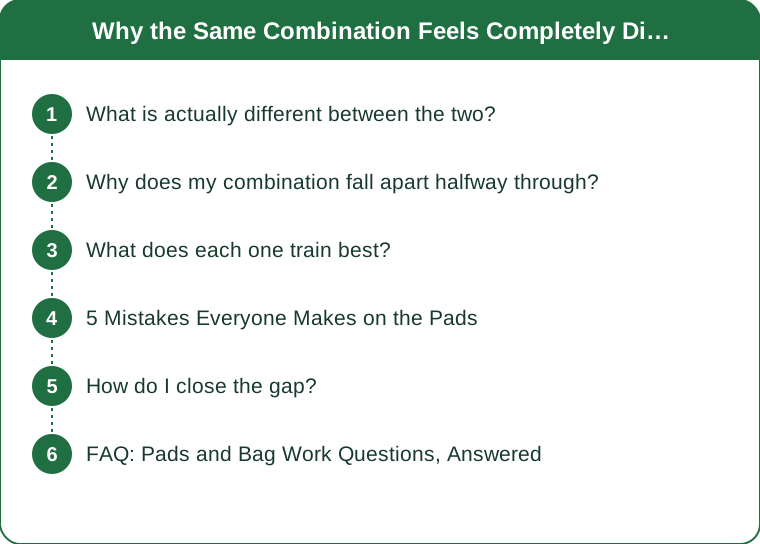
What is actually different between the two?
The bag does not move and you do not have to read anything. You can start when you like, at the distance you like, and every punch lands at a depth you have already chosen. That is enormously useful for power and conditioning and it removes the entire timing problem.
Pads move, and reading them is a separate skill. You have to see the target appear, judge the distance, and commit — all within a fraction of a second, and usually while the coach is also moving their feet.
The distance is set by someone else. Most people’s combinations are calibrated to a bag they have stood in front of for months. Pads held two inches closer or further completely change which punches land clean.
Feedback is different. A bag swings and tells you about power. Pads make a sharp sound and tell you about accuracy and timing, which is why a punch that feels good on the bag can sound terrible on a mitt.
And there is a person watching. That alone changes performance for most people, and it is worth naming rather than pretending it does not matter.
Why does my combination fall apart halfway through?
Because you learned it as a fixed sequence rather than as a response. A combination drilled on a bag becomes a motor pattern you play back. On pads the second punch has to account for where the first one landed.
Your feet are usually the problem. On a bag, feet drift and it does not matter because the target does not move. On pads, drifting feet mean the third punch arrives at the wrong distance, and that is the one that misses.
Reset time disappears. Bag work allows a small pause between combinations without consequence. Pad work is continuous, so the recovery you did not know you were taking is suddenly gone.
The hand you are not punching with stops working. Guard drops faster in pad work because more of your attention is going to reading the target, and a good coach will punish it, which is exactly the point.
And you are thinking. Anything you have to consciously recall is slower than something trained to automaticity, and pad work exposes precisely which parts of a combination you have actually automated.
What does each one train best?
The bag builds power, structure and conditioning. Hitting something with real mass teaches you to punch through a target rather than at it, and it is the only tool that gives you resistance.
Pads build timing, accuracy, distance and reaction. They are much closer to sparring than bag work is, and they are where combinations become responses rather than recitations.
Shadowboxing builds the movement itself. No target, no resistance, no distraction — pure mechanics and footwork, and it is the piece people skip most.
Sparring is the only place all of it comes together against someone with their own plan, and everything else exists to prepare you for it.
You need all four, and in that order of progression. Trying to fix a timing problem with more bag rounds is one of the most common training misallocations in boxing.
And they expose different weaknesses. Your bag work reveals conditioning gaps; your pad work reveals technical ones. Both are useful information.

5 Mistakes Everyone Makes on the Pads
Punching at the pad instead of through it. The mitt is a target, not a wall. Aiming to stop on the surface produces a slapping sound and no transfer; aiming a few inches beyond produces the crack you are looking for.
Standing still. Pad work is footwork practice disguised as punching practice. Anyone rooted to the spot is getting perhaps half of what the round offers.
Only throwing what was called. Good pad work eventually includes reading and responding rather than executing instructions, and staying in obedient mode indefinitely caps your progress.
Dropping the guard between punches. It happens more on pads than the bag because the cognitive load is higher, and it is the habit most likely to follow you into sparring.
Trying to hit as hard as on the bag. The fifth one is the most common and the most counterproductive — pad work is not a power test, the coach’s joints are attached to those mitts, and maximum effort ruins your timing and accuracy at exactly the moment you were meant to be training them.
And the bonus: not asking the coach what they were watching. Pad rounds contain far more information than they hand over unprompted.
How do I close the gap?
Do bag work with movement and a timer, not just rounds of hitting. Make yourself move in and out of range between combinations so the bag stops behaving like a stationary target.
Use a double-end bag. It is the closest thing to pads you can use alone, because it moves, it punishes bad timing and it demands accuracy.
Shadowbox the combination before you drill it. Getting the footwork right without a target first means the pattern is not built around a distance the bag chose for you.
Ask for the same combination at different distances. Any coach will do this, and it teaches you that the combination is a shape rather than a fixed set of arm movements.
Do fewer combinations, more repetitions. Three combinations trained to automaticity beat twelve you can only produce when called.
And do some pad rounds tired. Everything works in round one. The gap between your bag work and your pad work is widest in round four, and that is the round worth training.
FAQ: Pads and Bag Work Questions, Answered
How often should I do pad work versus bag work?
If you are training two or three times a week, one session including pads is a reasonable target. Bag work is easier to access and easier to do badly; pad work has more value per round and needs a partner.
Can I get good at boxing with only bag work?
You can get fit and you can develop real punching mechanics. Timing, distance and reaction need a moving target, and no amount of bag work substitutes for that.
Should I hit the pads at full power?
No. Sharp, accurate and fast with good structure is the target. Save maximum effort for the heavy bag, where nothing is holding it.
Why do I gas out faster on pads than on the bag?
Because the pace is set for you and the small recoveries you take on the bag disappear. It is also more cognitively demanding, and that has a real metabolic cost.
TL;DR:
- The bag lets you choose timing and distance; pads impose both, which is a different skill.
- Combinations fail mid-sequence because they were learned as fixed patterns, not responses.
- Bag builds power and conditioning; pads build timing, distance and reaction; you need both.
- Punch through the mitt, keep moving, hold the guard, and do not chase power on pads.
- Close the gap with a double-end bag, movement on the heavy bag, and pad rounds while tired.
Good on the bag means you can punch. Good on the pads means you can box.
Keep Reading
This article is for general informational and styling purposes only. Fit, sizing, and product availability may vary.