A Shadow Boxing Workout That Builds Something: 20 Minutes, 6 Rounds
Quick Answer: A productive shadow boxing workout runs in rounds with a single focus each — not continuous freestyle punching. Six 3-minute rounds with 30 to 60 seconds rest: footwork, jab, one combination, defense, high output, and freestyle. Give each round exactly one job. Unfocused shadow boxing builds cardio and quietly reinforces bad habits, because nothing corrects you when nobody is watching.
You put on music, you throw punches for twenty minutes, you sweat. It felt like a workout.
It was cardio. Whether it was training depends on whether any round had a job — and this is the difference between people who get better at home and people who just get tired at home.
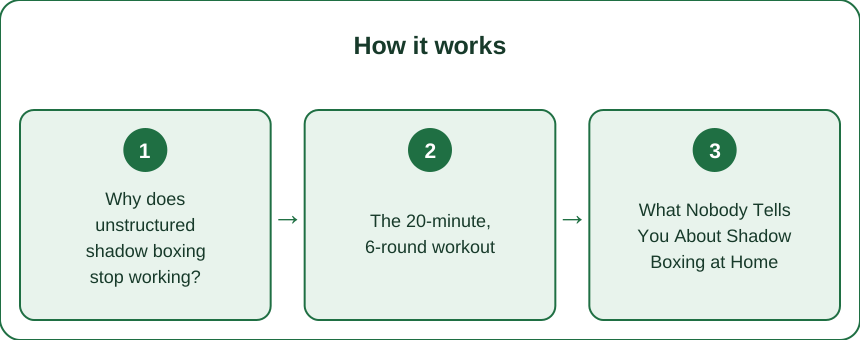
Why does unstructured shadow boxing stop working?
Three reasons, and none of them is effort.
No feedback loop exists. A bag tells you when a punch lands badly. A partner tells you when your guard drops. Shadow boxing tells you nothing at all, which means whatever you are doing — good or bad — gets rehearsed identically.
You default to your comfortable punches. Freestyle for twenty minutes and most people throw the same three combinations they already like. The gaps in your game go untouched, session after session.
Speed replaces quality. Without resistance, the natural drift is toward throwing fast and light with incomplete extension and no rotation. You end up rehearsing an arm punch, and arm punches are exactly what you do not want automated.
The fix is structure, not intensity. A round with one job — footwork only, jab only, defense only — forces attention onto the thing you would otherwise skip. A boring round with a purpose beats an exciting round without one.
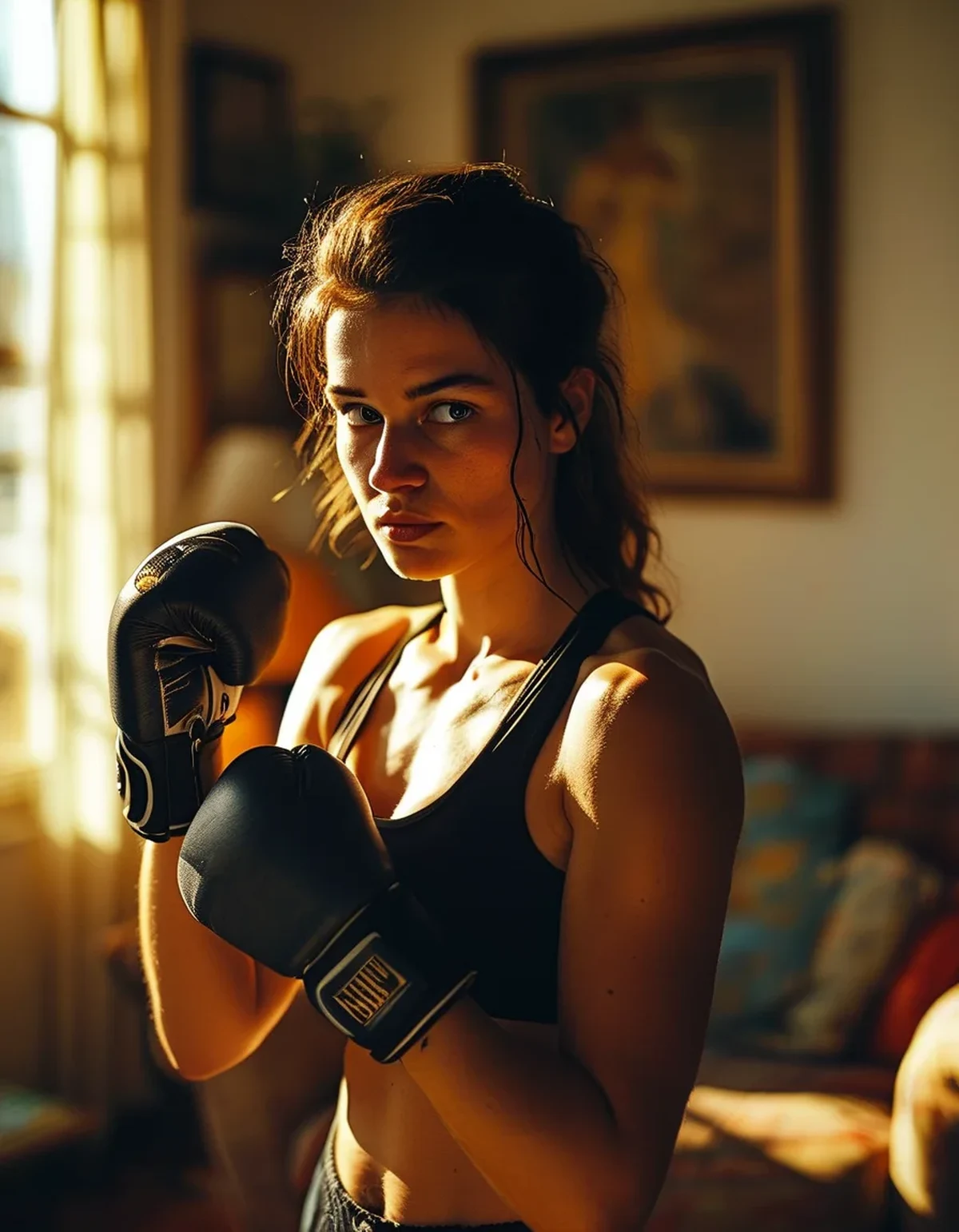
And use a mirror when you can. It restores the missing feedback loop for free, and a phone camera filming one round from the side does it even better.
The 20-minute, 6-round workout
Set a timer for 3-minute rounds with 30 to 60 seconds rest. Do not skip the rest — recovery between rounds is part of the adaptation, not an interruption of it.
Round 1 — Footwork only. No punches. Stance, step forward and back, lateral steps, pivots off the lead foot. Hands stay up in guard the entire round. Move continuously, never crossing your feet, never bouncing straight up and down.
This round is boring and it is the one that improves people the most. Footwork is what makes punches land, and it is the first thing dropped from every home workout.
Round 2 — Jab only. Just the jab, from a moving stance. Vary it: to the head, to the body, doubled up, a stepping jab, a flicking jab. Retract to your guard every single time.
The jab is roughly half of what gets thrown in real boxing and it is the punch most often thrown lazily in shadow work. Full extension, small rotation of the fist, hand straight back to your cheek.
Round 3 — One combination, repeated. Pick one — jab-cross, jab-cross-hook, or jab-jab-cross — and throw only that for three minutes, moving between reps. Same combination the entire round.
Repetition is how a combination becomes automatic. Rotating through eight combinations builds none of them.
Round 4 — Defense. Slip left, slip right, roll under, catch, step back. Punch only as a counter after a defensive movement. Imagine punches coming and answer them.
This is the round almost nobody does and the one that most separates people who look trained from people who look energetic.
Round 5 — High output. Punches in bunches, moving constantly. Not full power — full volume. 70% power, high pace, breathing out on every punch. This is your conditioning round.
Round 6 — Freestyle. Now put it together. Everything from rounds 1 through 5, at your own rhythm, with intention. This round is the reward for the five that came before.
What Nobody Tells You About Shadow Boxing at Home
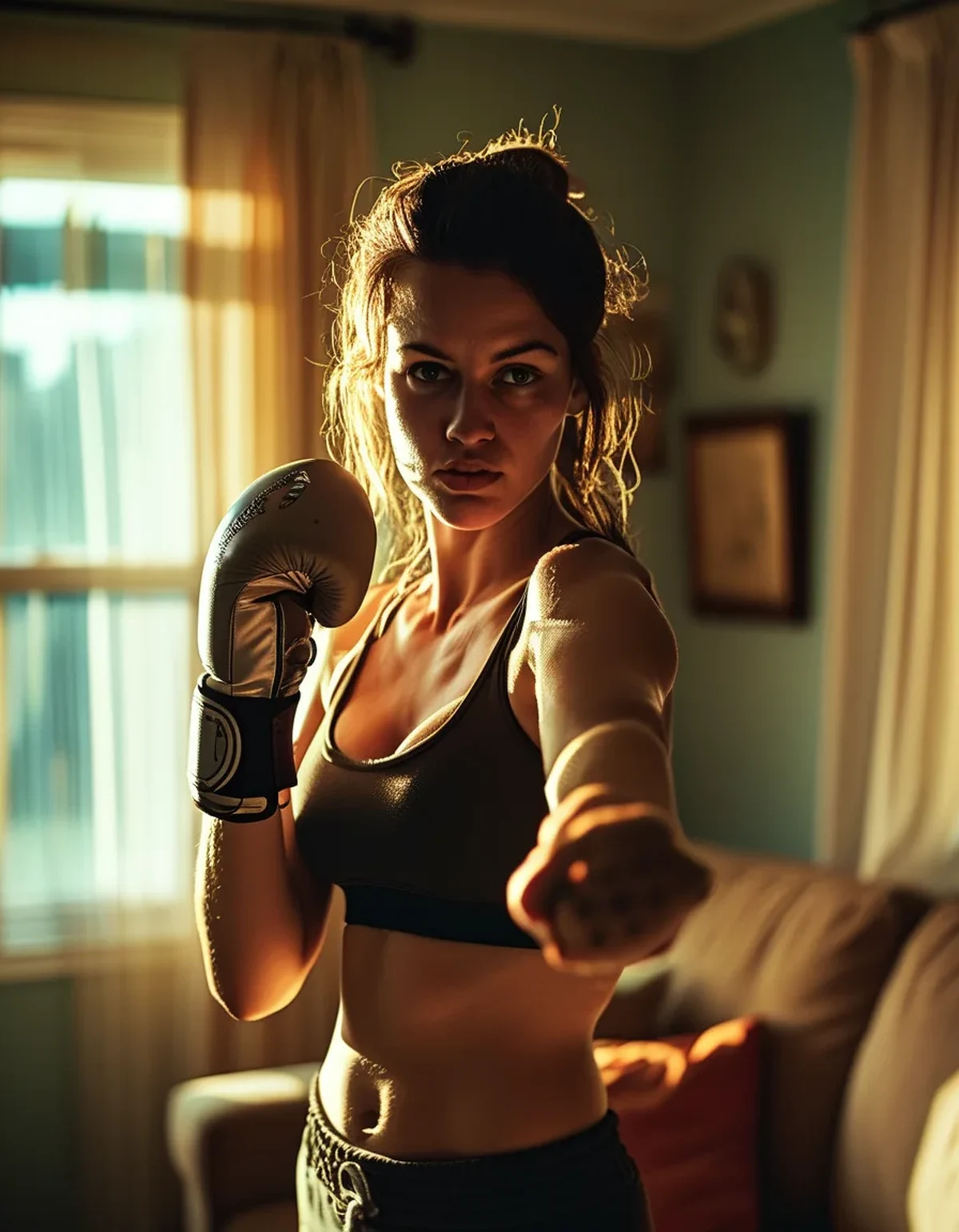
Your hands should return faster than they go out. Almost everyone throws fast and retracts slow. The retraction is where defense lives — a hand hanging out after a punch is an open face. Consciously snap it back and you will feel how much you were not doing it.
Breathe out sharply on every punch. A short exhale on impact. This is not a stylistic detail — it engages the core and it is the difference between arm punches and body punches, and it also stops you holding your breath through a round.
Do not lock out your elbows. Shadow boxing at full extension with nothing to stop the punch stresses the elbow joint repeatedly. Stop just short of lockout, every time.
Power comes from the ground. Rear foot pivots, hip rotates, then the shoulder, then the arm. If your feet are static, you are arm punching regardless of how the punch feels.
Chin down, eyes up. The single most common home habit is a lifted chin, because there is no consequence for it in an empty room.
Three rounds done properly beat six done vaguely. If your form degrades at round 4, stop at 3 and build up. Fatigued sloppy rounds are rehearsal for sloppy technique, which is worse than not training.
Light hand weights are a bad idea. They change your punch mechanics and load the shoulder and elbow through a fast range of motion. The tradeoff is not worth it — if you want resistance, use a resistance band anchored behind you.
How do I make it harder without a bag?
Add rounds, not weights. Eight rounds instead of six, or move to 4-minute rounds with 45 seconds rest.
Shorten the rest. Going from 60 seconds to 30 changes the conditioning demand substantially without touching your mechanics.
Add movement between rounds. Twenty squats, ten push-ups, or thirty seconds of high knees during the rest period. Punching while already fatigued is a specific skill and it is worth training deliberately.
Slow it down and go heavier on intention. A round thrown at half speed with perfect mechanics and full rotation is harder than it sounds and does more for technique than a fast round.
Use a resistance band. Anchored behind you and held in each hand, it loads the punch through its natural path without wrecking the mechanics that hand weights do.
Film one round a week. Watching yourself from the side is uncomfortable and is the fastest technical improvement available to anyone training alone.
FAQ: Shadow Boxing Questions, Answered
Is shadow boxing enough on its own?
For conditioning, technique refinement, and stress relief, yes — it is genuinely valuable and it is how professionals warm up and drill. For learning to handle impact and for real power development, a bag adds something shadow boxing cannot.
How often should I do it?
Three to five times a week is comfortable for most people. It is low impact on your joints compared to running, so frequency is limited more by shoulder fatigue than by recovery.
Should I wear gloves?
Not necessary and some people prefer light wraps for wrist support and the feel of it. There is no impact, so the protective purpose does not apply.
Why do my shoulders burn more than my arms?
Because holding your guard up is an isometric shoulder hold, and that is usually the limiting factor before your arms are. It is a sign you are keeping your hands up, which is the correct problem to have.
TL;DR: Rounds with jobs. That is the entire difference.
- Six 3-minute rounds: footwork, jab, one combination, defense, high output, freestyle.
- One focus per round. Freestyle for twenty minutes rehearses your existing habits and nothing else.
- Round 1 is footwork with no punches — the boring round that improves people most.
- Retract faster than you extend, exhale sharply on every punch, and never lock out the elbow.
- Use a mirror, or film one round a week. It replaces the feedback loop shadow boxing lacks.
- No hand weights. They alter mechanics and load the shoulder badly. Use a band if you want resistance.
Set a round timer tonight and do the first three rounds only. The footwork round will tell you exactly how much you have been skipping.
Keep Reading
This article is for general informational and styling purposes only. Fit, sizing, and product availability may vary.